

I’m currently studying the Upaniṣads—esoteric narratives that carry cryptic and hidden meanings, largely inaccessible to the casual reader. These works are dense, paradoxical, and at times agonisingly confusing. Earlier Vedic literature deals with religious piety and worldly prosperity, catering to the endless cravings that most people can’t shake off. The Upaniṣads are on a mission to radically expose the emptiness of it all. They elevate the discourse. Stereotyped into life’s monotonous cycles, good people toil hard, sacrifice endlessly, remain bravely hopeful, only to be frustrated in a game they can’t win. Worse still, a game they just can’t give up. Material happiness is an oxymoron. Chewing the chewed and writing new versions of the same story. Stringent laws of nature dictate the rising and setting of the sun, soon bringing our small lives to an abrupt end. Adding insult to injury, nobody remembers—not you, not them, not the world. Material life must transition into its next cycle. All that remains is a long list of names in the annals of history that nobody really references again. We did it yesterday; we’ve been doing this for lifetimes. Will this cycle ever end? Who will expose the madness? What will wake us up? The Vaiṣṇava commentators illuminate beauty beyond the illusion.
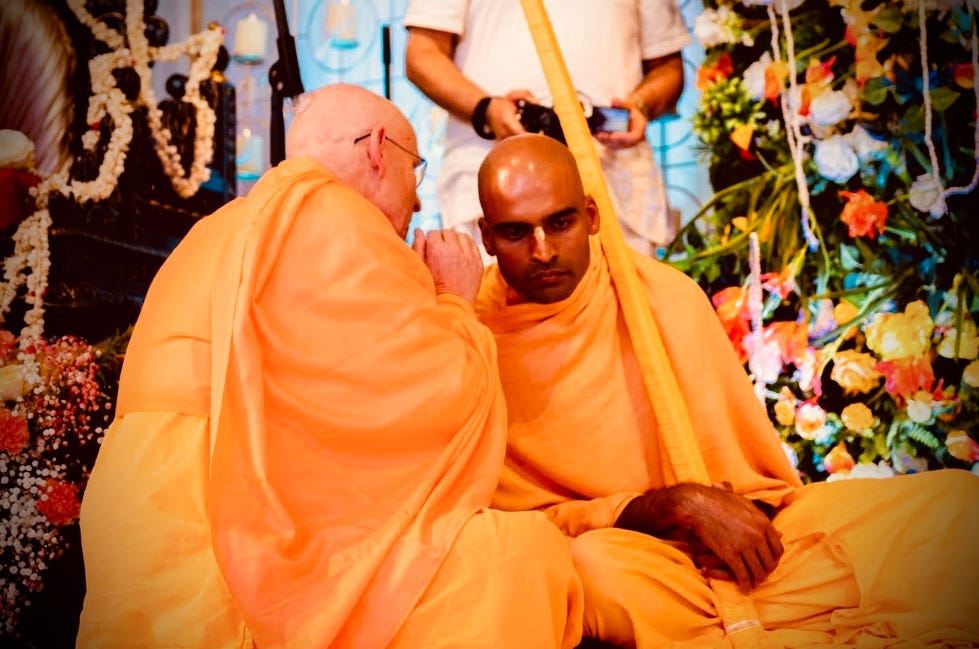
The etymology of Upaniṣad is itself instructive. Interpretations include: “to sit down near someone”; “confidential or secret session”; “beneath a higher authority”; and “teaching, instruction or command.” There is a thread here. Each one reveals the centrality of the teacher-student bond, dismantling the modern fantasy of self-mastery. The depressing fate of the noble soul can’t be circumvented by a heroic solo effort. We need knowledge, and we need it from a living embodiment. Thus, students would “sit close by,” while Upaniṣadic wisdom would flow into their consciousness through meaningful encounters with a guru. This is a mystical, subtle epistemology. True learning doesn’t simply draw from the head, but absorbs the invisible from the heart. The saintly souls convey way more than just information—they pulsate with faith, humility, strength, enthusiasm, and realisation. The student who “sits close by” gets infected. This is a delicate, almost surgical, cultivation and sensitising of consciousness. Spiritual formation.
In the Kaṭha Upaniṣad, Naciketas is granted three boons by Yama and saves the final one to ask the most crucial question of all: what becomes of a person after death? In Chāndogya Upaniṣad’s exchange between Śvetaketu and Uddālaka, the boy returns home after twelve years of study, self-assured and polished, only to be stumped by a simple question from his guru. Exposure precedes insight; he must begin again. The account of Satyakāma approaching Gautama reminds us that entry into Upaniṣadic knowledge is not by birthright but by unwavering honesty. In the Bṛhad-āraṇyaka Upaniṣad, King Janaka, the powerful sovereign, sits next to Yājñavalkya, who interrogates him: what light sustains us when the sun has set, the moon has vanished, and all fire is extinguished? Indra and Virocana both approach Prajāpati eager to learn, yet they depart with radically different conclusions, receiving only what they’re ready for.
Fascinating interactions! And what about today? Modern education becomes increasingly impersonal, shifting from one-to-one to one-to-many. Personalism evaporates, and learning starts looking very transactional. These interactions are then mediated by devices which obliterate presence, while emerging tech tries to banish the living teacher altogether. Can we still, in any meaningful way, “sit close by”? The realities of life may preclude physical proximity, yet the distance cannot endure: a meeting of hearts is required. To move beyond formality and convention, to listen more deeply than words, to respond beyond duty and expectation. The student must connect—deeply, genuinely. Without this, education risks becoming efficient, entertaining, engaging and eloquent—and, in the end, quite empty. And so, before an Upaniṣadic reading, we pray:
Oṁ saha nāv avatu saha nau bhunaktu saha vīryaṁ karavāvahai
tejasvi nāv adhītam astu mā vidviṣāvahai oṁ śāntiḥ śāntiḥ śāntiḥ
Oṁ. May He protect both teacher and student. May He nourish us both. May we work together with great energy and vigor. May our study be luminous and enlightening. May we never be hostile toward one another. Oṁ. Peace, peace, peace.
This is breathtakingly beautiful!
It brought to my mind this verse from Rumi:
“At the end of my life, with just one breath left, if you come, I’ll sit up and sing.”
The mystical encounter of hearts , even at the very end of life ; awakening Love,
and bestowing Grace.
May it be .
I needed to hear this today. Reading it feels like all the answers to my questions are here. In this moment of rapid change, as the world we knew is collapsing, we can stay together, pray together, and nourish each other’s hearts through study and love. Thank you Swami.