

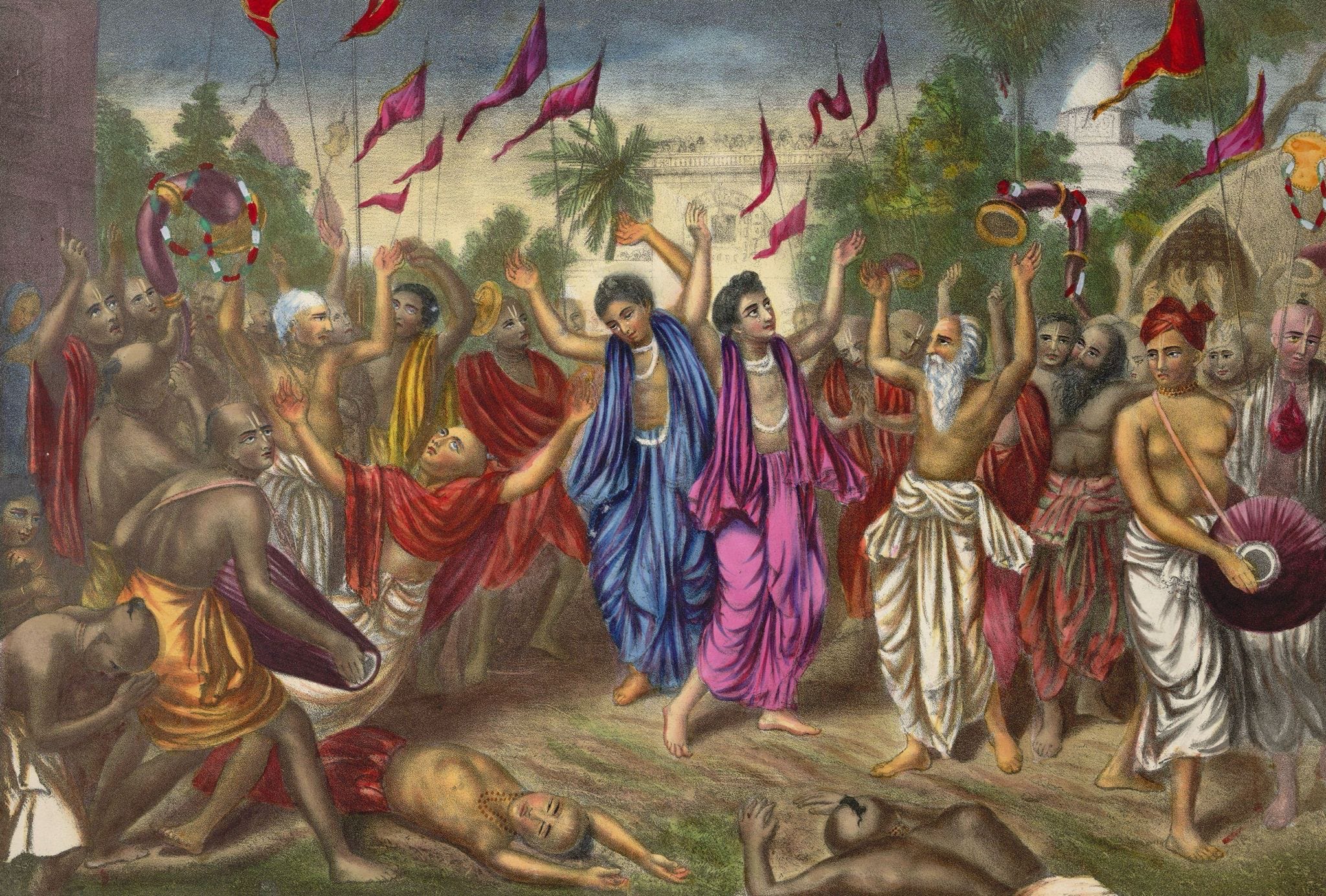
It is the turn of the fifteenth century. A punishing heat settles over Bengal, yet the marketplace buzzes, oblivious to the sun’s tyranny. Every other stall offers food; some display cloth or spices on woven mats. In the background, the echoing call to prayer rises from a nearby mosque. Goats wander, children chase one another, women fill baskets and balance them on their heads, while merchants count coins with rapt attention. Suddenly, a sound displaces the steady pulse of the market. From the narrow lanes, emerges a colourful procession: immaculately coordinated, armed with drums and cymbals, smiling faces alight with delight. They sing sweetly, leaping off the ground, drawing gasps from bemused onlookers. The tempo surges and the line between procession and public blurs. Bystanders enter the commotion, inhibitions dissolve, and their bodies sway in free-flowing ecstasy. The rhythm pounds through the market, demanding the attention of all, as the instrumentalists escalate their energy yet remain perfectly harmonised. Voices amplify, emotions intensify, fellowship solidifies… the cymbals crash and the spectacle reaches a crescendo! In these moments, the sun, the marketplace and all daily affairs disappear into insignificance.
These are the followers of Śrī Caitanya, and this is the saṅkīrtana movement. Kṛṣṇa descends as the golden apostle of love, confronting spiritual apathy and ushering heartfelt devotion into the public sphere. His message: to encounter God, simply call on His Name with love. Everything else is secondary. This phenomenon of nagara-saṅkīrtana—public chanting—continues to spread across the world: kīrtana is performed in high streets, shopping malls, train stations, theatre halls and even nightclubs. Śrī Caitanya boldly prophesied that Kṛṣṇa’s names would resound in every town and village on earth. It’s happening. It’s exciting. It’s infectious. Nearly forty years ago, I was a kid, visiting Amsterdam with my family. On a cold, rainy, weekday morning near Dam Square, a party of Hare Kṛṣṇas swept by. From a side street, I saw them—faithful, colourful, joyful… utterly unusual. It left a deep impression. When I visit Amsterdam, it hits me like a flashback—I know the exact spot from where I watched them. Once the name descends, life is never the same.
The explosive missionary fire of Śrī Caitanya’s ministry of sound is accompanied by a mystical inner dimension. He is a theological enigma, unparalleled in history. When a devotee cries for God, it is touching. When God cries for his devotee, it is beautiful. But when God, utterly captivated by the love of his devotees, is impelled to become a devotee to experience that cry for himself, it is unprecedented. This is Śrī Caitanya: God who surrenders dominion to taste the soul’s cry. He enters the world not as overlord, but incognito and undercover. In doing so, he teaches us how to really cry. We have shed countless tears—some visible, many silent—over loss, longing, and painful letdown. One poet says the accumulated tears spilled in many lifetimes of material frustration would be enough to fill oceans. Śrī Caitanya inspires an entirely different cry, channelled through chanting the Name. The loving cry in the company of saints, without a trace of ego, devoid of material attachment, brings a welcome end to all futility. The syllables invite one into the endless world of song and dance.
To inspire your cry, I share a beautiful poem from Śacīnandana Swami, entitled “The Road of Tears”:
The disappointed disciple with a heavy heart speaks:
“Who can say I’ve never tried?
All those mantras I’ve chanted…
All those vows that kept me awake for so many lonely nights…
All those pilgrimages, sacrifices, holy baths in ice-cold water…
What to speak of persistently ignoring the requests of my mind and senses
to do what is most dear to them!
The result?
NOTHING!
All this has brought me to, at present, is desperation.
The old emptiness in the heart has only become greater!”
The guru replies:
“It seems you have done your best
to come before the Divine Couple.
But have you ever tried to act in such a way
that They can come before you?
Have you yet built
your road for Them?
The road of tears?”
Disciple:
“The road of tears?
What tears?”
Guru:
“Tears of the soul.
There are different kinds of tears –
‘body tears’
we cry in physical pain;
‘mind tears’
we cry when emotionally hurt;
and sweet tears
that come from the soul
as it awakens to its only real need.
The soul’s need is to enter into the One relationship.
“And this road of tears can’t be found on any map.
It begins from your own heart.
But it is so attractive to the Divine Couple
that They cannot even imagine ignoring it.
Just to begin building this road
makes Them feel They must come before you!”
The disciple:
“Does this road need many tears?
I have cried all my tears for other things.
I am completely empty inside.
How can I possibly build this road?”
The guru, enthusiastically:
“Don’t worry!
There are oceans of tears
arrested in your heart.
You only need to learn
to direct them to the right cause…
Then they become released.
But before a downpour,
there is a flash of lightning.
Similarly, there has to be a divine revelation -
the golden Radha, and
the cloud-blue Krishna
have to appear in the heart.
Then the water gushes forth.
Sweet tears of longing for the Lord,
whom you once gave up.”
On Tuesday, 3rd March, we celebrate Gaura Pūrṇimā, the full-moon anniversary of Śrī Caitanya’s appearance in 1486. Learn more about his life in Caitanya-caritāmṛta Compact
Check out this wonderful rendition of the poem here! https://www.youtube.com/watch?v=WS0Jx_K9KBY
What a wonderful novella and a beautiful poem! Thank you Maharaj for sharing this inspiration!
I'm longing for stepping on my road of tears..