

Plato’s Republic is renowned in the world of philosophy and political theory. His project is audacious: to model the “ideal city.” Within the dialogue, Plato depicts the “tripartite soul,” dividing the human psyche into three: reason (logos), which seeks truth and knowledge; spirit (thumos), which seeks honour and self-worth; and appetite (eros), which craves bodily pleasure—food, sex, and money. All goes well, in city and soul, when reason rules, supported by spirit, keeping appetite carefully in check. To preserve this harmony, the Republic is strictly governed, with prohibitions, regulations and aggressive protection against destabilising forces. Amongst banned things, one is striking: the flute! Yes—you heard it right—the flute! For Plato, it’s not a trivial target. The flute’s emotional intensity, he says, can weaken character, trigger moral decay, and “bewitch” the soul into rebellion against the rational order.
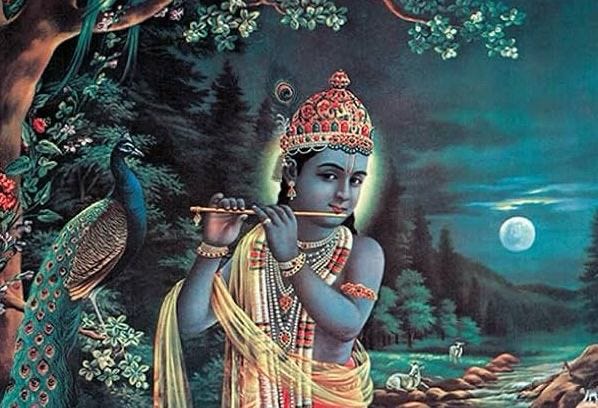
For Kṛṣṇa lovers, Plato’s policy is unthinkable, yet its underlying intuition is remarkably perceptive. The father of Western philosophy was onto something! The Bhāgavata Purāṇa describes the commotion that ensues from Kṛṣṇa’s flute song. The instrument is radically simple—a humble hollow stick—yet through it, Kṛṣṇa exerts extraordinary power. Its unearthly melody insists everyone stop, turn around, and rush back towards the source. The sound is disruptive, divisive, and destructive—in the most beautiful way. It fractures the foundations of humdrum life, bringing ordinary activity to a standstill, eclipsing all competing claims on desire and attention. In that sound, natural laws fall away, reversing the predictable movements of man and matter. Kṛṣṇa’s flute stuns and then invites the world to dance.
Bhāva—spiritual emotion—lies at the very heart of the Bhāgavata. When founded upon immaculate spiritual purity, it represents the soul’s most intense encounter with God. Emotion without purity can damage and destabilise, spiralling into a downward trajectory. Purity without emotion, however, remains inert and bland, failing to satisfy the soul’s irrepressible hunger for love. Plato’s policies, while excising the risks of emotion, also eliminate the ecstasy of bhāva. Reason alone won’t do! While it’s essential for balanced, ordered life—what Vedic teachers call dharma—Kṛṣṇa’s devotees, in complete purity, abandon even this anchor in the pursuit of loving devotion (bhakti). The image of Kṛṣṇa with a conch evokes his Bhagavad-gītā call to achieve mastery over the lower nature. Yet when Kṛṣṇa exchanges that conch for a flute, something inexplicably wonderful occurs: the soul awakens to spiritual emotion and the ineffable dynamics of pure love.
Plato’s story, however, doesn’t end with the ban. A recently deciphered scroll portrays the philosopher on his deathbed. In that decisive, life-defining hour, he is said to have requested a single sound as the last he would hear. Plato called for a flute player! The instrument he banished returned at the hour of death! May we, too, also hear that call—and have the courage to follow it. Below is a short flute meditation (headphones recommended). May it offer you some respite from the turbulence of the world and a tiny glimpse of what lies beyond the immediate drama that is “my life.” May you disconnect and remember… it’s all but a flash in eternity… just passing through…
(Credit: Flute narration adapted from “Without Krishna there is no Song” by David Kinsley)
Hare Krishna maharaj, please accept my humble obeisances. Thank you very much for this wonderful meditation on Krishna's fulte. very very grateful to you.
your servant
Prem Nartan das.
Beautiful ❤️