

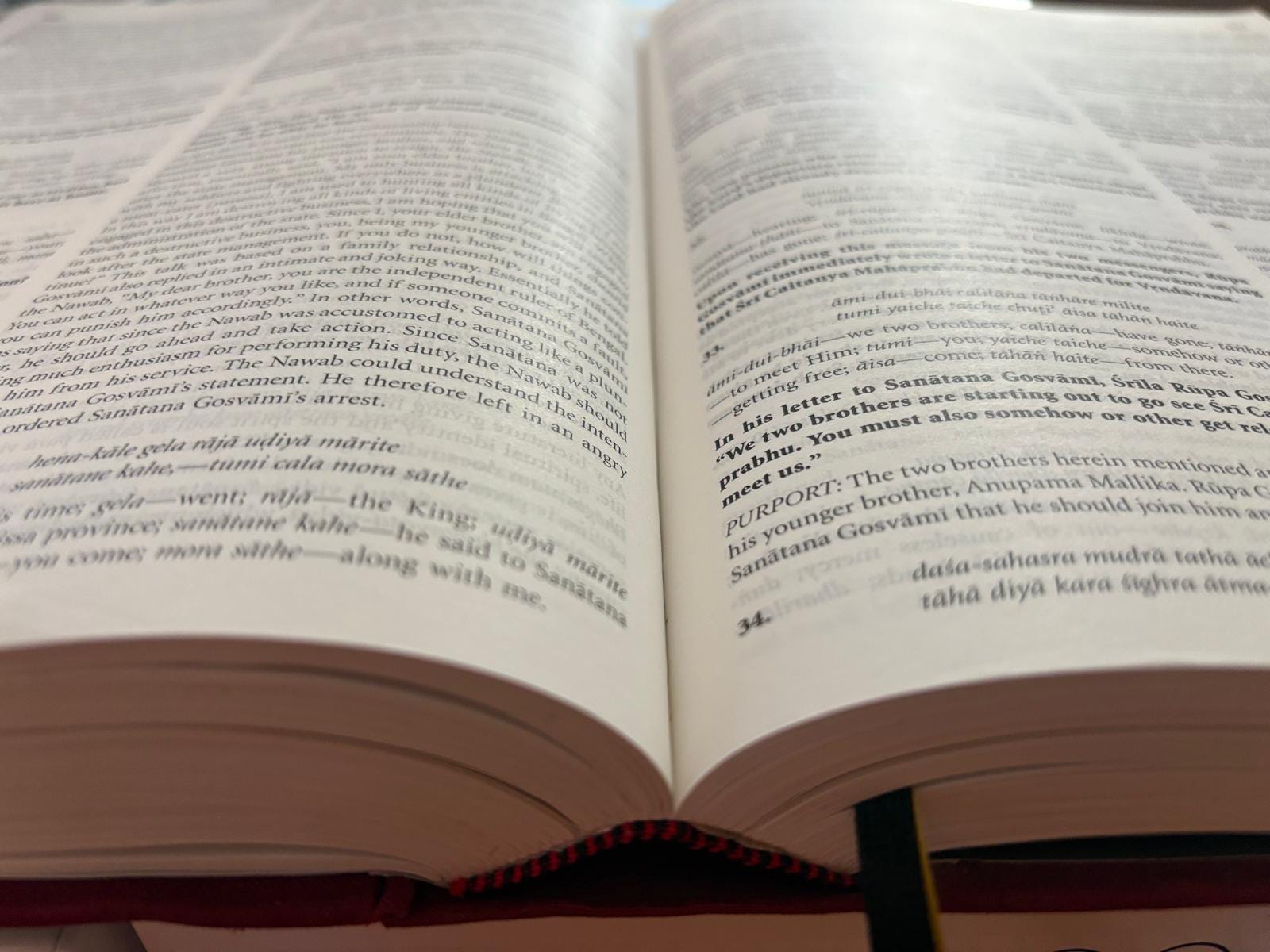
What goes through the mind of God? Few would dare to ask such a question, yet Kṛṣṇadāsa Kavirāja Gosvāmī pursues it relentlessly in his magnum opus, Caitanya-caritāmṛta, revealing the inner life of God. That book sits before me as I write. Three weeks prior to my spiritual master’s departure from the world, he called me into his room. “I am not leaving you anything in my will,” he said. “Only service.” Pointing to his desk—where the Caitanya-caritāmṛta rested—he told me to take it, study it deeply, and write about it. The world must know this book. It was a gift—beautiful, but weighty. It lifts me each morning, and then makes me bow in feelings of insignificance. In recent months, I’ve been spending the early hours with the Caitanya-caritāmṛta. Such texts must reveal themselves; we can only offer rapt attention and wait patiently for an audience. Day by day, periodic glimpses illuminate the landscape of my life. Recently, it occurred to me that something I received forty-five years ago had already foretold this.
April, May, June—three months, three milestones. In May ‘81, my material birth gave me the name Sandeep. In April ‘08, my spiritual birth gave me Sutapā dāsa. In June ‘22, my social death—entry into the renounced order—gave me S.B. Keśava Swami. A name is only letters, yet it carries hidden blessings and a deep meditation. On these days, nothing changes—and everything changes. Each name has shaped me, and I always assumed the spiritual ones mattered most. My initiated name speaks of austerity—never trade what you want most for what feels good now. My sannyāsa name turns the mind toward Kṛṣṇa— the goal, sustainer, master, witness, refuge, and most dear friend. Without Him, nothing makes sense. I carried the name Sandeep (Sanskrit: Sandīpa) for sixteen years before grasping its literal meaning—“complete illumination.” Only recently has its full weight begun to land.
The fourth verse of the Caitanya-caritāmṛta, considered foundational, distils the book’s ultimate aim. It invites us to seat the golden Lord—Śrī Kṛṣṇa appearing as Śrī Caitanya—within the innermost chamber of the heart. There, radiant and resplendent, He dispels all darkness and grants complete illumination. There it is! Sandīpa. In my earlier pride, which tends to persist, I assumed Sandīpa meant one who offers illumination. Here, the Caitanya-caritāmṛta calls each of us to become completely illumined (sandīpitaḥ). The verse reads as follows:
hariḥ puraṭa-sundara-dyuti-kadamba-sandīpitaḥ
sadā hṛdaya-kandaresphuratu vaḥ śacī-nandanaḥ
(Caitanya-caritāmṛta 1.1.4)
The plot thickens: kadamba-sandīpitaḥ. On its own, it reads: “one completely illumined by Kadamba.” My mind moves to my spiritual master, Kadamba Kānana Swami, who handed me the book and masterplanned my life. Perhaps the Caitanya-caritāmṛta will be the fulfilment of my birth name. It binds me to the text—and clarifies my place before it. To not read simply to write; to read to be set right. Complete illumination. Sandīpa. Kadamba-sandīpitaḥ. I sit, focus and pray that the text may speak to me. It has become my study, my meditation, and my daily wonder. Nowadays, I browse many books and turn many pages, but the Caitanya-caritāmṛta is where I return, eager to see what will unfold. Tony K. Stewart wrote his thesis on the Caitanya-caritāmṛta and titled it The Final Word. That phrase speaks on multiple levels. But in the ultimate sense, once one has entered the mind of God, what else remains to be said? Where else is there to go? Caitanya-caritāmṛta—"the immortal acts of Śrī Caitanya”—isn’t a book that you finish, but a world that you disappear into.
Very beautiful and wondrous tapestry you've woven here of your names, your spiritual master, and this mystical book. I am inspired to open this one up now.
Hare Krishna Maharaj 🙏 Dandavat Pranam 🙏 this is so beautiful Maharaj.. Your realizations are always beautiful... kadamba-sandīpitaḥ!