

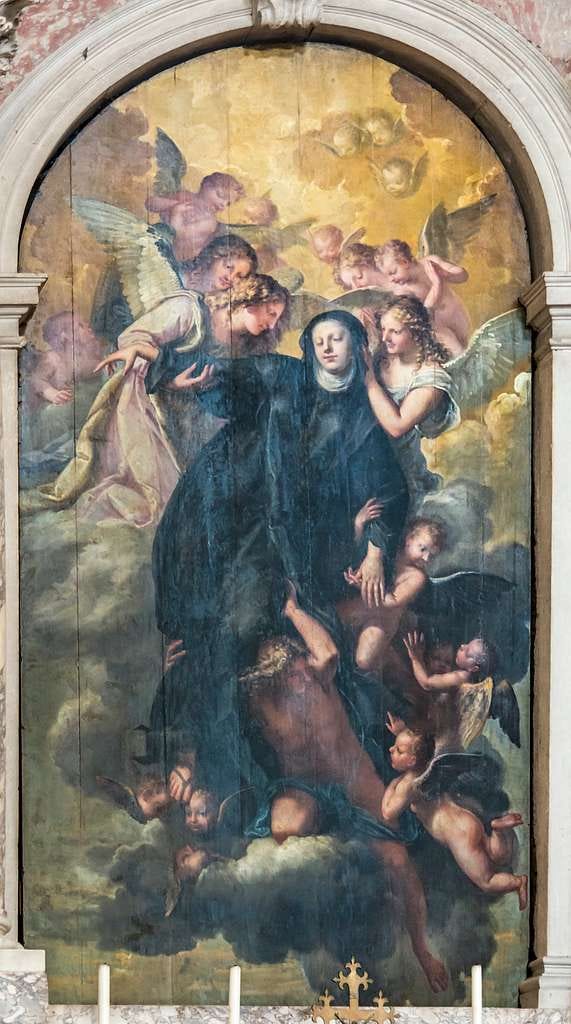
My last lecture was on Wednesday, and now I’m finishing final papers. In our “Kṛṣṇa and Christ” course, the final theme was “divine marriage,” explored through the Āḻvār saint Āṇṭāḷ and Saint Gertrude of Helfta. These mystic women envisioned their marriage with God, renouncing all other claims upon their lives. No divided loyalties. Their profound visions, layered poetry, and intensity of longing demand close attention; their writing is not for skim reading. In the Tiruppāvai, Āṇṭāḷ enters the mythic world of the gopīs, eagerly waking her companions from slumber, determined to win Kṛṣṇa through the sacred vow and remain with him forever. Gertrude of Helfta, in the Exercitia spiritualia (“Spiritual Exercises”), writes in poetic prose to internalise the steps of spiritual marriage, addressing Christ from the “earthquake of her heart” which generates “voracious flames” of spiritual longing. I once asked a mentor how to recognise the true sannyāsī. “They know the Absolute Truth,” he replied, “and they know nothing else.” The second part was sobering. As I read Āṇṭāḷ and Gertrude I’m forced to reconsider who the real sannyāsī is.
Love and marriage were still on my mind when, at a Tufts University event on Monday, I was asked about the difference between religion and spirituality. I compared spirituality to love, and religion to marriage. Some people fall in love first and then marry; others marry first and discover love over time. Sometimes love exists without marriage, and sometimes marriage exists without love. Human experience resists neat formulas. The point of my analogy was to avoid an aggressive demarcation between spirituality and religion, but rather to suggest their synergistic potential. Just as love and marriage can nourish and deepen one another, so too spirituality and religion can exist in a dynamic and reciprocal relationship. In the case of our saints, formally married or not, Āṇṭāḷ and Gertrude were entirely consumed by love.
This week, I’m finishing a paper entitled “Wounds of Love,” in which I bring Saint Francis of Assisi and Śrī Caitanya Mahāprabhu into conversation. Here are two figures whose spiritual emotion became so intense that it ruptured their physical body. Saint Francis received the wounds of Christ in the stigmata, while Śrī Caitanya displayed the aṣṭa-sāttvika-bhāva, or eight ecstatic bodily transformations. They were triggered in different ways: Saint Francis through an intense participation in the suffering of Christ, and Śrī Caitanya through profound feelings of separation from Kṛṣṇa. Reading, researching, reflecting and re-reading—sustained contemplation spirals you into their mystical world and awakens a wonder. What would it be like to awaken such absorption?
As of yet, my own heart remains untouched. A real sannyāsī is “one who knows the absolute truth… and knows nothing else.” I’m not there. Who can shed a tear—a real tear—for Kṛṣṇa? In Sufi tradition, the death anniversary of a saint is called an ʿurs, which literally means a “marriage.” Death signifies union with the divine, the consummation of a lifelong burning. That brings to mind the Sufi saint Rabia Basri, who once walked through the streets of Basra carrying two buckets—one filled with fire, the other with water. Asked what she intended to do, she replied: “With the fire I’ll burn heaven, and with the water I’ll extinguish hell.” Real religion, she taught, was not about attaining heaven or avoiding hell—it was about awakening love in the here and now. And love means longing… “I really want to see you.” One great hope, is that God wants to see us. I began my Harvard journey with Kṛṣṇa unexpectedly appearing in my very first lecture through “My Sweet Lord.” Strangely enough, in the final lecture of the year, another professor was moved to end in precisely the same way (see video below). I guess you can always rely on Kṛṣṇa to show up.
Time flies! I remember that first day in the classroom as if it were yesterday, and I loved hearing ‘My Sweet Lord’ playing. Today ends just the same – a great sign that you’ll continue to be blessed by Krishna.
Congratulations!! 🧡🩵🤍💜
Congratulations.🙌🏼 Thankyou for sharing your very inspiring personal journey, and for digging deep into these precious ancient teachings.The above seems to guide towards opening the heart fully for a unique experience of unconditional love without man made labels or boxes. It feels like the Divine waits patiently orchestrating our path to release fear and experience love through relationships. A spiritual path opens a door to connect with the Divine through that open heart. Thankyou for being a shining light for the world and spreading love through an open heart. Hare Krishna. 🙏❤️🙏