

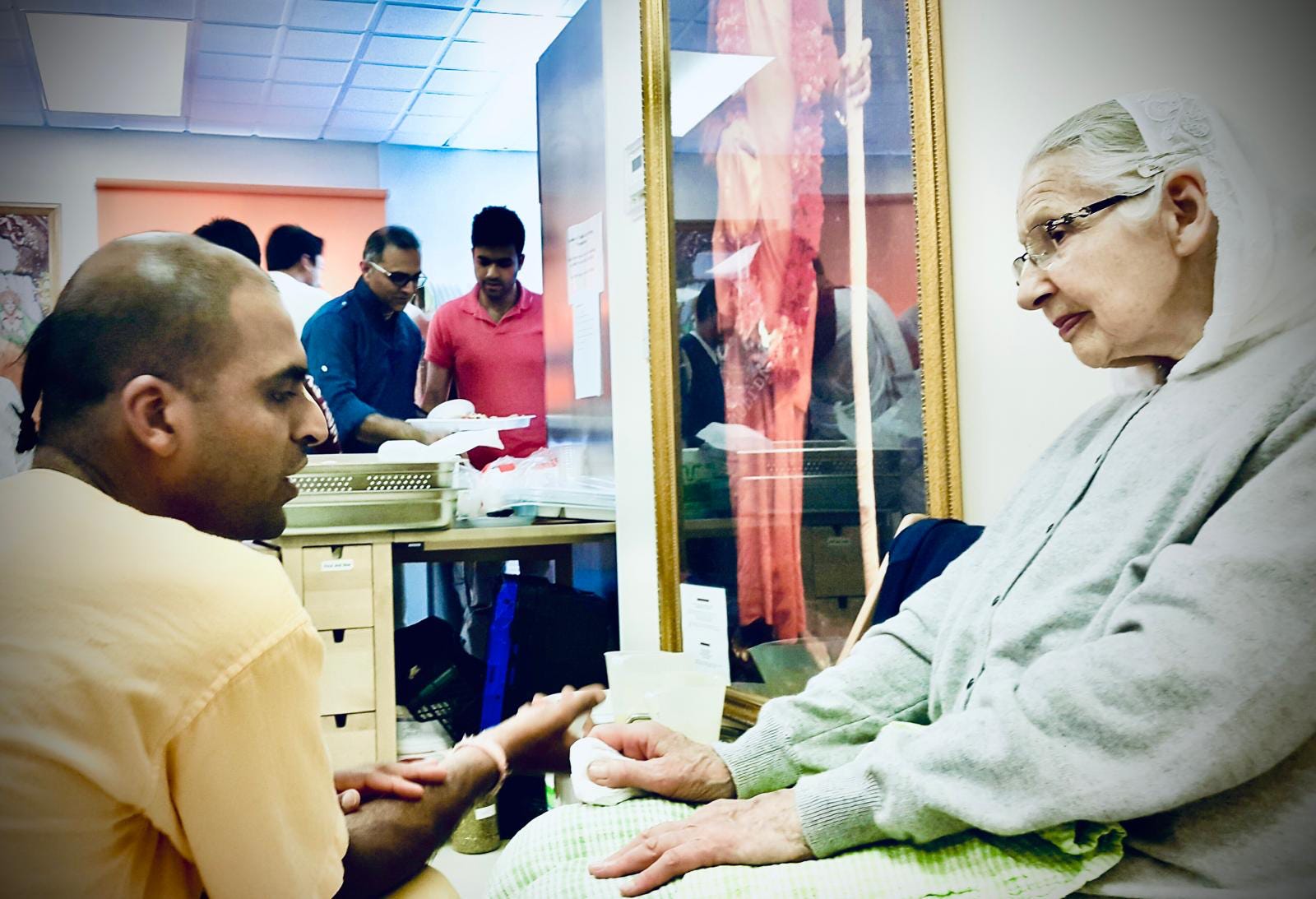
Past midnight, I stumbled in after a late event, half-asleep, and headed straight for the āśrama. At 4.00am, life kicks off again—late nights and early mornings are not ideal. As I ascended the staircase, I glanced sideways down the echoey corridor and was forced to stop. A figure caught my eye. At this hour? Dressed in white, crouched over, gently swaying in prayer, pulsating with intensity, and oblivious to the world: Mother Kulangana. First out of the blocks: “What is night for all beings is the time of awakening for the introspective sage.” (Bhagavad-gītā 2.69). Over the years, I’d have had this privileged sight multiple times. While the world slept, she was preparing for what comes next. No pretence or performance. After all, this was the business end of life. Standing there, I forgot my sleepiness, at least for the time being. She was the embodiment of everything I had been speaking about that evening. A living theology.
1932, Poland. That’s where her story begins—and it already tells you much. Mother Kulangana lived through a war-torn Warsaw: bombings, scarcity, constant threat, and uneasy proximity to death. As a young girl, she was separated from her mother. For us who’ve lived sheltered lives, it’s a story we can’t really inhabit. Somehow, she survived it all—illumined by witnessing the full range of the “dark side.” Later, she effortlessly renounced everything, dedicating her life in selfless service to Kṛṣṇa. Mother Kulangana showed up every day, for over four decades, right till the last breath. She was the quintessential wise elder, stronger than a thunderbolt, and softer than a rose. Lived experience, wise in scripture, and a heart devoid of envy—what a combination! I braved a question now and again, and always left the conversation enriched. There was weight behind each word, and every answer left a resounding echo. The insights of elders tend to keep returning, reminding us of what we didn’t grasp the first time around.
Mother Kulangana reminded me of Kuntīdevī from the Bhāgavata. Consider Kuntī’s trajectory: she loses her firstborn soon after delivery; shortly after marriage, her husband dies; she raises five sons amid toxic family intrigue; her own relatives conspire to dispossess them; she endures thirteen years of separation from her children; and after all that, a fratricidal war annihilates most of her family. Against that backdrop, her prayers shine even brighter. She asks that calamities come “again and again,” seeing them as a catalyst for intensity and intimacy with God. She values “material exhaustion,” recognising that comfort and extravagance can blunt one’s sincerity. She wishes all worldly attachments to be severed, envisioning her attraction flowing toward God “like the Ganga to the ocean” (Bhāgavata Purāṇa 1.8.24-44).
What is a community without elders? Some see the passage of years as a decline, but perhaps it’s a maturation—like a ripened fruit whose fullest flavour emerges. Life, in its later stages, can yield its most distilled insight. We equate reduced energy with diminished value, a bias shaped by a culture that prioritises productivity over depth. Yet those who no longer produce or perform at speed often contribute at a higher level: clarity, judgment, and hard-won wisdom. To ignore those who came before us is to divorce ourselves from accumulated insight. No generation discovers truth entirely anew; it inherits, contextualises, and rearticulates in ways that speak to its own time and language. As Newton observed, “If I have seen further, it is by standing on the shoulders of giants.” Mother Kulangana was one such giant.
Beautifully said. What stayed with me is the sense that elders do not only preserve wisdom, they embody a living continuity we did not begin ourselves. There is something deeply true in that.
Beautifully articulated and utterly relatable. I was blessed to care for my elderly mother in the last two years of her long life (she left her body at age 98 years in 2022). In those last two years she finally chose to experience what my sister Raga Devi Dasi and I had been urging her to try for herself. To our delight, our mother began to chant Hare Krishna and discuss the spiritual teachings of Srila Prabhupada that Raga and I follow. Guru and Krishna are so kind! Gaura premanandi!!!