

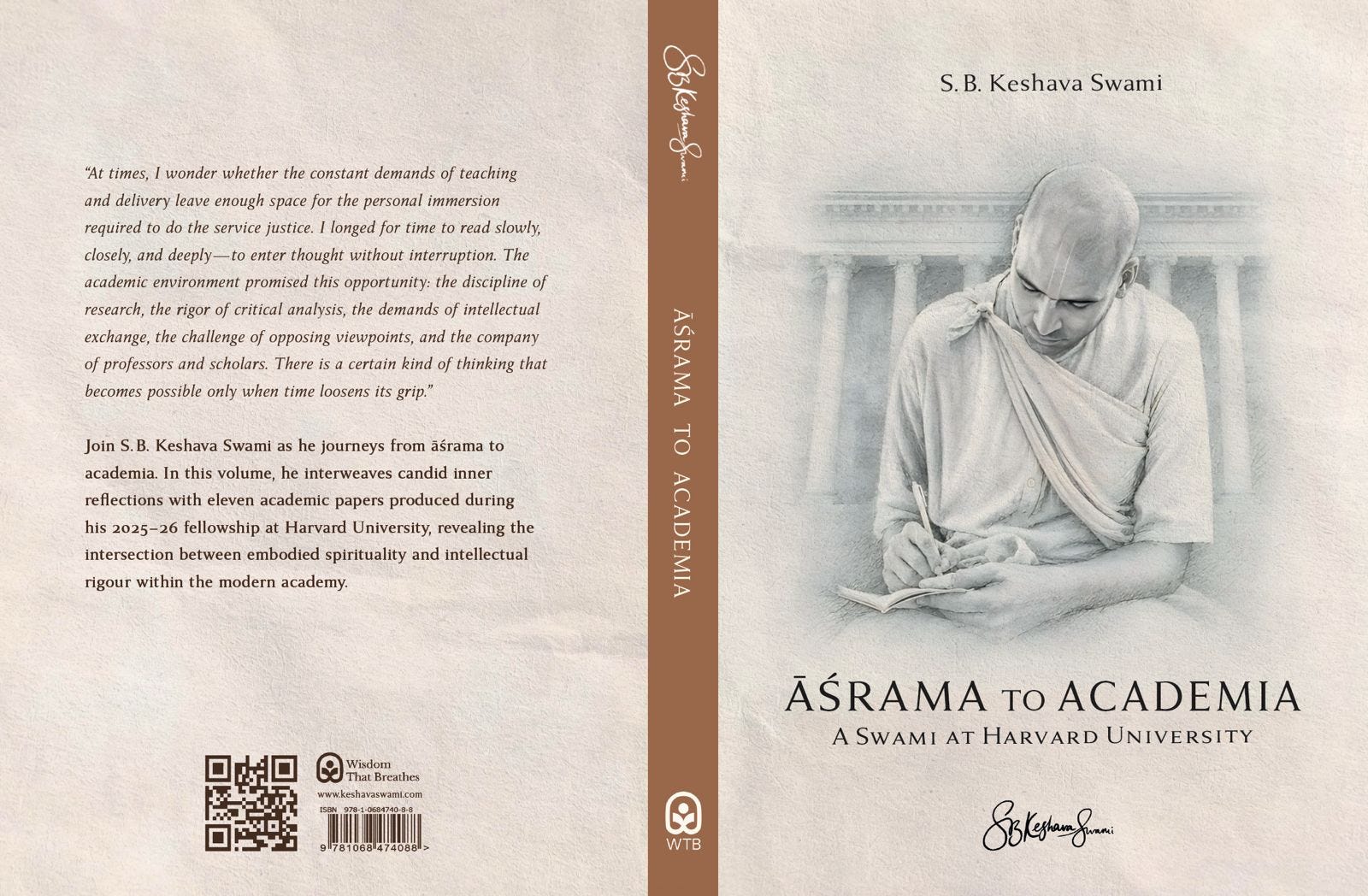
Finishing a book signifies the completion of another phase of life. Looking back, we join the dots: lessons crystallise, gratitude deepens, and the road ahead comes into sharper focus. I often tell the story of how, at twenty-one, I graduated from academia and entered the āśrama. This new book tells the story of how, twenty-five years later, I reversed the trajectory and went from āśrama back to academia. (You can read the introduction here).
The transition from the Western academy to the Eastern āśrama was a culture shock. While university had occupied one part of my life, the āśrama demanded totality. From 4:00 a.m. until 10:00 p.m., the daily rhythm was ordered around spiritual formation: predawn worship, private meditation, close textual study, menial service, pastoral care, and missionary outreach. Aged twenty-one, my guiding principles became humility, austerity, celibacy, obedience, service, and devotional learning. In the āśrama, one learns to subordinate desire to authority, to ritualise time, to quieten impulse, and to detach from the sensory saturation of the social world. Monastic training offers the breathing space to restore our lost participation in the eternal.
Why, twenty-five years later, would a monk re-enter academia? To enroll at Harvard was to enter the liminality: a life space in which we exist “in-between” identities, ejected from the steady rhythms of our created world. When established structures loosen their grip, we see ourselves, our life, our purpose, and our contribution in a new light. Harvard was a creative interval: the anti-structure where the familiar was destabilised. I was no longer a teacher, now just an inquisitive student. No longer a leader, but simply called to follow the programme. No longer a traveller, but rooted in one place and tied to timetables and classrooms. Still a Swami, technically—but that identity carried little currency here. Just as my first exposure to academia uncovered a deeper purpose, I knew this encounter would invite new revelations.
This book offers a personal account of my journey through Harvard—not merely as an academic immersion, but as a spiritual and existential excursion. The first section reveals the human experience of a monk at university: weekly reflections, moments of intellectual disruption, encounters that unsettled me, ideas that illuminated me, and the ongoing dialogue between scholarship and spirituality. The second section contains eleven academic papers written during the year. You will notice a more formal approach in the writing, yet I hope it remains accessible, intellectually alive and spiritually chaste. Academia demands a different mode of authorship: not writing as an isolated voice speaking into silence, but entering the conversation—with historians, theologians, philosophers, critics, and centuries of accumulated argument.
I hope that Āśrama to Academia is as intellectually and spiritually generative for you as my time at Harvard University proved to be for me. May it open new horizons of inquiry and cultivate a lifelong passion for learning.
I have known Svāmījī since he took sannyāsa and have followed his lectures over the years. What has always struck me is that he is both a genuine sādhu, grounded in humility, austerity and devotional learning, and a true intellectual in tune with modern society and theology. Following his honest reflections from Harvard on social media, I felt how being stripped of the teacher's role to become a student again transformed his teaching style, more conversational and in dialogue with history, philosophy and the modern world, without ever diluting the fundamental teachings of Gauḍīya Vaiṣṇavism he professes. For those of us who have watched his journey from the early āśrama to academia and back, this book is a beautiful joining of the dots.
Cannot wait to get this book Swamiji 🌼